A Transparent Guide to Commercial Video Production Scope
Communicating complex engineering capabilities, heavy machinery workflows, or specialised technical services requires more than standard promotional collateral. Modern industrial buyers demand clarity, operational credibility, and technical precision. High-definition commercial video production bridges the communication gap, distilling intricate processes into compelling visual narratives that shorten sales cycles and establish brand authority.
Despite the proven returns of visual communication, marketing directors and operations leaders frequently encounter ambiguity when scoping budgets. Understanding commercial video production pricing is critical for industrial leaders who must justify capital allocations against measurable commercial outcomes.
Below is a hypothetical commercial video production project breakdown, detailing the lifecycle, resource allocation, and direct cost structure of an enterprise-grade industrial video project.
The Strategic Value of B2B Commercial Video Production
Industrial visual marketing involves operational variables absent from traditional corporate shoots. Operating environments often feature active machinery, stringent occupational health and safety protocols, and complex physical assets.
Effective B2B video production requires technical literacy alongside cinematic capability. The production team must understand how mechanical systems function to frame them accurately, highlighting precision engineering without compromising plant safety or production schedules. A disciplined production framework ensures every hour on set translates into a multi-channel marketing pipeline.
Project Case Study: Turnkey Technical Showcase
Industry: Industrial Engineering & Manufacturing
Objective: Produce a flagship technical video showcasing heavy fabrication capabilities, specialised welding, and assembly workflows for enterprise sales pitches, trade exhibitions, and digital channels.
Format: Multi-camera 1080p Full HD captured at high frame rates (60 FPS) to enable clear, slow-motion mechanical analysis.
Phase 1: Pre-Production & Engineering Discovery
The foundation of cost containment in high-stakes filming environments is thorough pre-production. Before dispatching camera crews to an active facility, every sequence must be scripted, storyboarded, and approved.
Strategic Scope & Preparation
Discovery & Narrative Architecture (10 Studio Hours): Detailed stakeholder briefing sessions, scriptwriting, technical shot list preparation, and pacing design tailored for industrial decision-makers.
On-Site Reconnaissance (4 Hours): Technical location scouting to evaluate workshop ambient lighting, power availability, acoustic interference, and site safety parameters.
Prototyping & Approvals (2 Studio Hours): Scratch voiceover recording synced to visual animatics for executive sign-off.
Financial Allocation
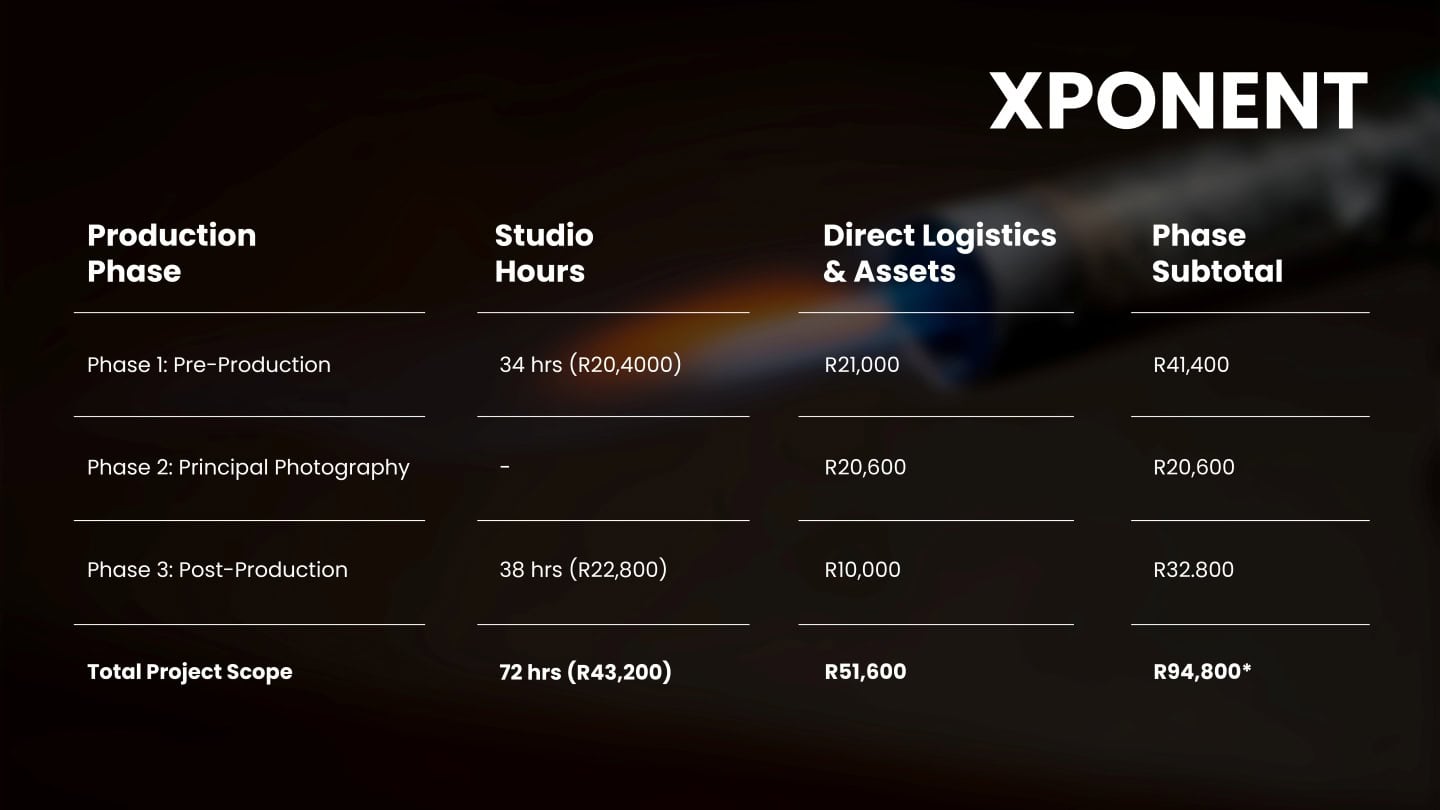
Studio & Technical Planning: 34 Hours @ R600/hr = R20,400
Direct Logistics & Staging: Studio stage hire (R4,000), green screen backing (R1,700), specialised technical props (R15,000), consumables & sundries (R300) = R21,000
Phase Total:R41,400
Phase 2: Active Workshop & On-Site Filming
Filming in operating industrial plants requires a compact, agile footprint to protect facility productivity while capturing high-impact visuals.
Field Execution Scope
Two-Day Principal Photography: Deployment of a specialised production crew across two full operational days.
Multi-Camera Deployment: Primary cinematic camera on dynamic gimbals alongside a secondary static rig for stable, long-exposure mechanical tracking.
Controlled Plant Lighting: Deploying mobile LED fixtures, diffusion panels, and industrial-grade power management to balance harsh workshop shadows and high-contrast welding arcs.
Daily Workflow Review: End-of-day clip collation and delivery of edited 30-second dailies, providing engineering leads immediate quality verification without delaying site operations.
Financial Allocation
Specialist Production Crew: 2 Full Production Days @ R10,000/day = R20,000
Capturing RAW footage is only half the investment. Post-production transforms disparate plant footage into an authoritative narrative that aligns with broader marketing objectives.
Editorial Scope & Sound Design
Data Ingestion & In-Engine Prep (4 Studio Hours): Media verification, checksum ingest, clip transcoding, and colour-space alignment.
Editorial Assembly (40 Studio Hours): Timeline curation, dynamic pacing, technical callout placement, colour grading, and formal first-cut review iterations.
Sound Engineering & Multi-Format Mastering (10 Studio Hours): Professional voiceover narration by an industry-appropriate voice talent, foley sound integration, high-resolution audio mastering, and final exports formatted for web, digital advertising, and large-format trade show displays.
Financial Allocation
Editorial & Color Grading Studio Time: 38 Hours @ R600/hr = R22,800
*All prices exclude VAT and reflect typical scope parameters for heavy industrial video operations.
Strategic Takeaways for Industrial Marketers
A turnkey visual asset delivers business value long after initial project delivery. When structuring your media production budget, keep three operational principles in mind:
Pre-Production Mitigates Plant Disruptions: Operational downtime in manufacturing or fabrication is costly. Rigorous storyboarding, safety clearances, and shot lists prevent operational delays and eliminate the expense of plant re-shoots.
Specialised Lighting Is Mandatory: Industrial plants are notoriously difficult visual environments, dominated by high ceilings, mixed-temperature lighting, and reflective metal surfaces. Allocating resources to dedicated lighting gear and multi-angle camera setups ensures clean, high-end footage.
Compound Asset Repurposing: A single turnkey production yields substantial secondary value. In addition to a primary technical overview video, the captured raw footage yields website hero backgrounds, micro-clips for LinkedIn campaigns, sales presentation collateral, and trade booth visuals.